

Skytsengel
This project is the result from the course "Design-driven Innovation" at the IT University of Copenhagen, as part of my master's degree in Digital Design and Interactive Technologies. The project was a collaboration with the Danish Stalking Center, a non-profit organization that provides support to stalking victims.
The Problem
Skytsengel was designed as a safety app for stalking victims, featuring alarm buttons that connect users to their personal network of "helpers", and a system for storing evidence against their stalkers. While the evidence collection feature was functional and well liked aside from some usability flaws, our research revealed a critical flaw in the app's second functionality: many stalking victims lose their social connections due to the isolating nature of their experience.
The app's core functionality required users to invite friends and family to download the app and serve as emergency contacts. For victims who had become isolated, lost trust in others, or whose networks didn't understand their situation, the app was essentially unusable.
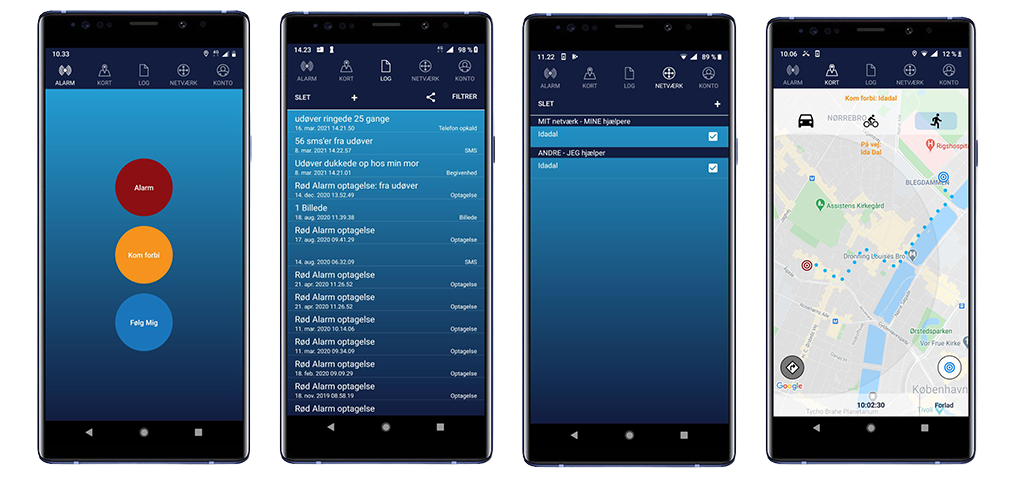
Screenshots featuring the main functions of the current version of Skytsengel. ©Dansk Stalking Center
Research & Discovery
Understanding the Users
We conducted in-depth interviews with:
- Two stalking victims
- A psychologist specializing in stalking cases
- A police officer from the Danish police stalking unit
Key Insights
Isolation is Universal
“I completely disappeared from his field of view. I moved, changed jobs, and stopped going out. I wasn't even with friends who still had contact with him.”
Every victim we spoke with described profound isolation - whether self-imposed for safety or resulting from others' inability to understand their situation.
Knowledge Gaps Create Additional Barriers
Victims, their families, and even some professionals lacked understanding of stalking dynamics, leading to:
- Dismissive responses from support networks
- Inappropriate advice that could escalate danger
- Victims feeling misunderstood and withdrawing further
False Security is Dangerous
The original app's alarm system could create overconfidence in situations where immediate police contact (112/911) would be more appropriate.
Design Process
Reframing the Problem
Initially focused on adding features to the existing app, we realized we needed to fundamentally rethink the user's relationship with the technology.
Original Problem: How do we improve the existing alarm and logging features?
New Problem: How might we provide consistent support to stalking victims who don't have reliable social networks?
Ideation & Concept Development
Through collaborative brainstorming sessions, we shifted from thinking about the app as a tool to conceptualizing it as a supportive companion. We explored various ideas, including:
- A chatbot that could provide emotional support and safety tips
- A social network for victims to connect with others in similar situations
- A tool for creating and sharing safety plans with friends and family
The Solution
Design Principles
- Always Available Support - No dependency on external networks
- Empowerment Through Knowledge - Education reduces fear and isolation
- Professional Guidance - Direct access to expert support
- Emotional Wellbeing - Address psychological impacts alongside safety
Key Features
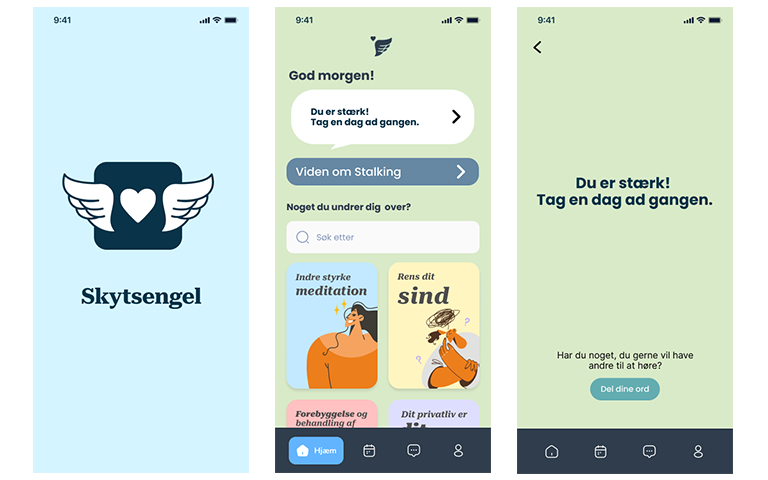
Supportive Home Experience
- Daily motivational messages replace stark alarm interface
- Mindfulness exercises and coping resources
- Warm, encouraging visual design with soft colors and the redesigned logo
Knowledge Center
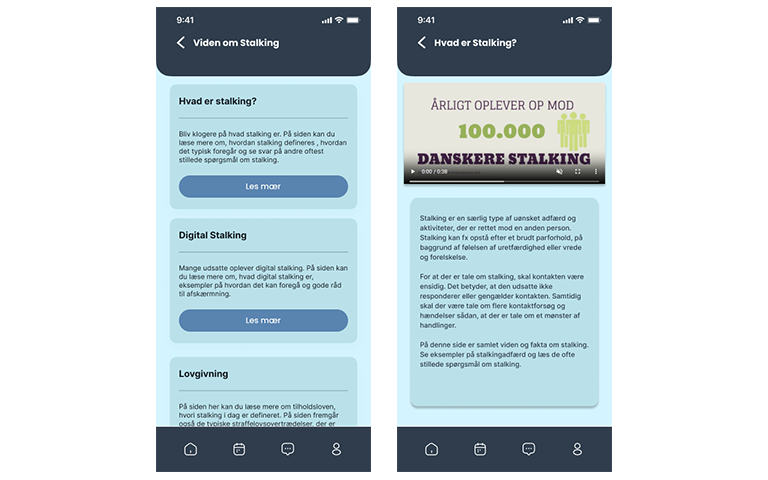
- Comprehensive stalking education section
- Practical safety information
- Resources for understanding legal processes
- Content designed to empower rather than frighten
Professional Support Chat
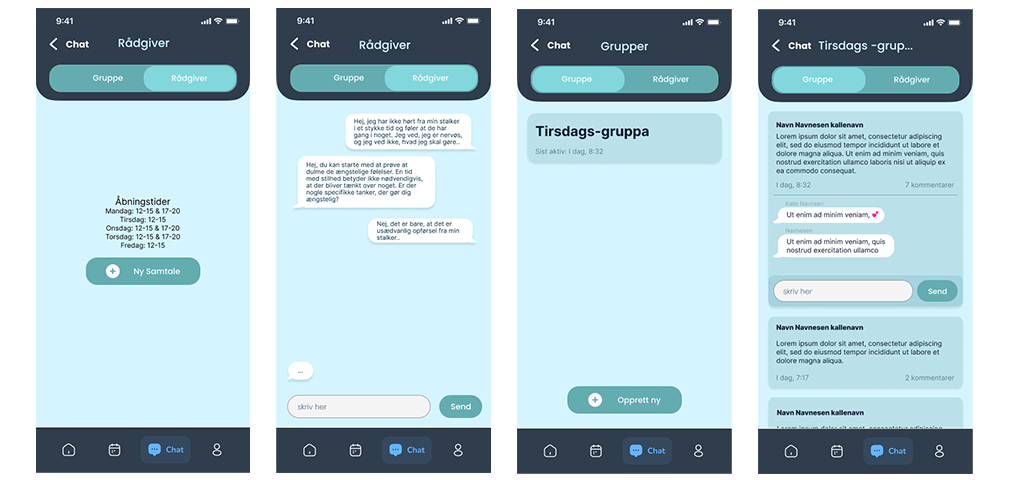
- Direct messaging with Danish Stalking Center counselors
- Moderated peer support groups
- No need to involve personal contacts
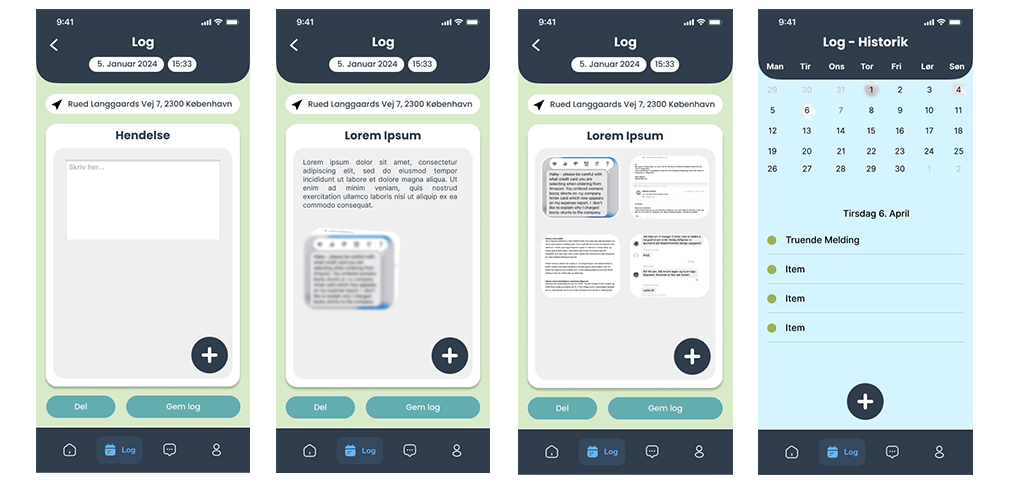
Enhanced Documentation
- Calendar-based incident logging
- Improved photo/video/audio attachment functionality
- Streamlined export for legal proceedings
- Visual timeline of events
Visual Design Evolution
Before: Clinical, alarm-focused interface that felt intimidating
After: Warm, supportive design that feels like a caring companion
The redesigned logo maintains the protective angel concept while feeling more approachable. The interface uses calming colors and encouraging language throughout.
Design Decisions & Rationale
Why Remove Network Dependency?
Our research showed that requiring users to build a helper network actually excluded the most vulnerable victims. By providing professional support directly through the app, we ensure everyone has access to help.
Why Focus on Education?
Knowledge gaps created additional trauma for victims. By providing clear, expert information about stalking, we help users:
- Understand they're not alone
- Make informed safety decisions
- Communicate effectively with law enforcement
- Maintain agency in their situation
Why Emphasize Emotional Support?
Traditional safety apps focus solely on crisis moments. Our research revealed that daily emotional support was equally important for recovery and maintaining safety behaviors.
Results & Impact
Immediate Outcomes
- Expanded accessibility to victims without support networks
- Reduced isolation through professional and peer connections
- Increased safety knowledge leading to better decision-making
- Maintained core functionality while adding supportive features
Feedback
The Danish Stalking Center responded positively to our prototype, noting how it addressed gaps they'd observed in their current app usage. The design received particular praise for its sensitivity to trauma and focus on empowerment.
Challenges & Learnings
Designing for Trauma
Working with stalking victims required extreme sensitivity in research methods and design decisions. We learned to:
- Prioritize participant wellbeing over data collection
- Provide clear, actionable safety information
- Design for worst-case scenarios while maintaining hope
- Balance safety information with avoiding re-traumatization
Privacy & Security Considerations
The chat features raised important questions about data security and user privacy that would require careful implementation with legal and security experts.
Scalability Questions
Professional chat support would require significant resources from the Danish Stalking Center, raising questions about sustainable scaling.
Reflection
This project taught me the importance of questioning fundamental assumptions in existing products. What seemed like a feature enhancement problem was actually a complete reconceptualization of how technology can support vulnerable populations.
The most impactful design decisions often come from deeply understanding user contexts rather than focusing on interface improvements alone.